The Martin GE and V series are excellent guitars stock and you could nothing
to to them and still have a great guitar. However, they have more sound in
them and they are not as close replicas of late-30's Martins as they could be.
These are some of the
steps I usually take to get them sounding a little better. Go here
and here
for an idea of what can be done to 70's era Martins. Note that while these
modifications focus on the "Golden Era" models with an eye toward making them
more like the originals, most of the modifications apply to virtually any new Martin.
|
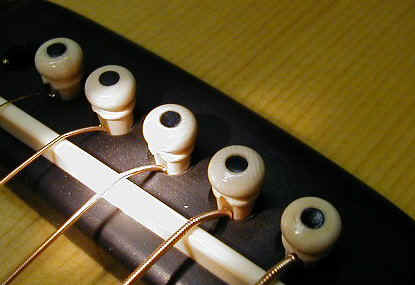
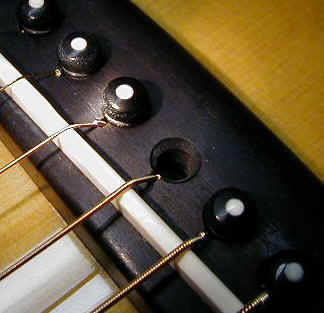
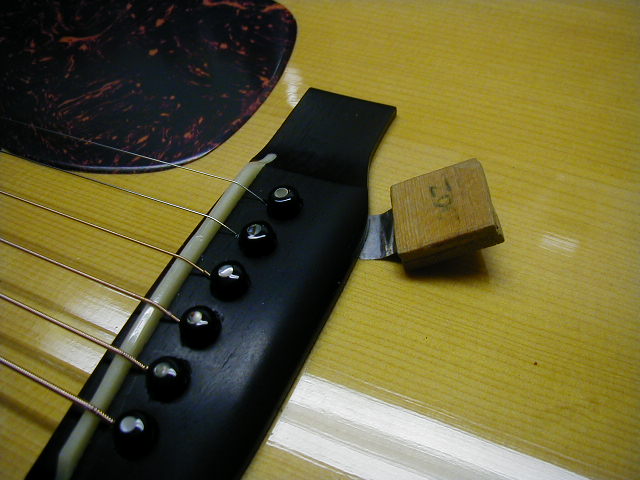
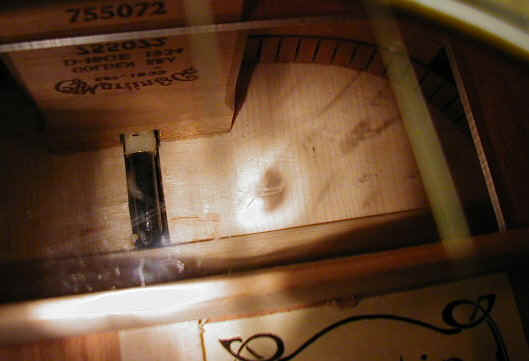
Notice how much the pins stick up on the stock
bridge. The pins are slotted, which means that the ball end is jammed in between the pin
and bridge plate. On the re-worked bridge (a D-18 GE here), the bridge is slotted and the
pins are not (slotted pins can be turned around). The string fits into a slot and
inside the guitar is supported on 3 sides by the bridge plate. You can almost, but
not quite, remove the bridge pins under full tension. The string's break angle is
much straighter (notice how the string curves when it meets the stock pin). And this
is the way it was done until about 1985 or so. I fit the pins individually so they
don't stick up 1/4" above the bridge. I replace plastic pins on D-18's with
either ebony, Antique Acoustics hard vintage plastic, or (as shown here) water buffalo. Water buffalo pins are a little
brighter, ebony is a little woodier sounding, and AA pins have smooth trebles.
The stock D-28 GE pins shown in the photo are mammoth ivory and I see little reason to change them
although I do slot the bridge and turn the pins around so that the slot faces the rear.
Regular D-28's have soft plastic pins and I replace these with either
bone, black water buffalo, ebony, or Antique Acoustics white plastic
pins.
Click for more discussion on slotted bridges. |
  |
While on the bridge, I re-shape or even replace the saddle if
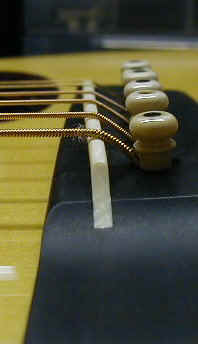
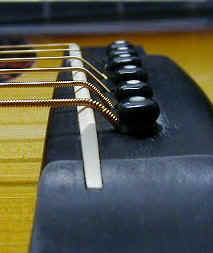
necessary. The stock saddle on GE's and V's is a round,
non-compensated shape. Some of the GE's I've gotten have even had almost flat-topped
saddles. I compensate and reshape the stock saddle to a rounder edge which gives
better bite on the string. I don't get it razor sharp (which would cause breakage
problems) but just define the shape a little more. Also, check out the difference in the
pin heights. If necessary, I'll lower the saddle height at this time, although
few
of the GE's I've worked on so far have required this. Quite the opposite,
actually. Many early GE's have the triple whammy of a high saddle, lots
of neck relief, and a low action. These are tough to get playing
really well.
I will often replace the stock fossil ivory saddle with bone.
Fossil ivory gives a smoother mellower sound and can be too soft
sometimes. Bone is harder, with a more aggressive and biting
sound. |
 |
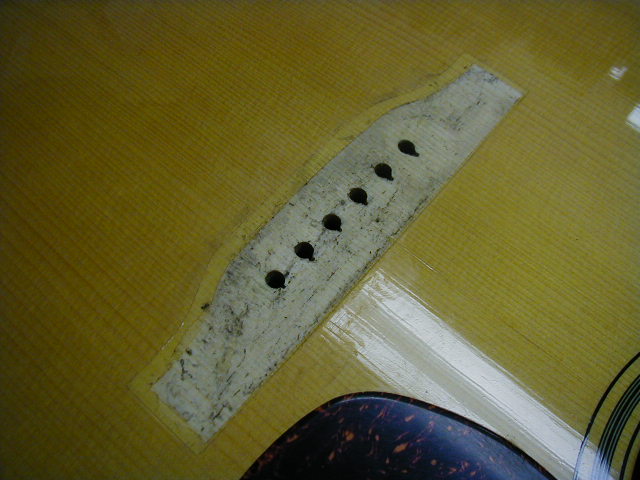
Another problem with the bridge is poor attachment. Here
I'm putting an .002" feeler gauge under the bridge. This is due to
Martin not cleaning the finish all the way out to the bridge outline.
Glue doesn't stick to finish very well, and since the finish is
.006-.008" thick the bridge simply does not make full contact with the
top. Martin has recently changed their bridge attachment method and
this only applies to pre-2010 Martins
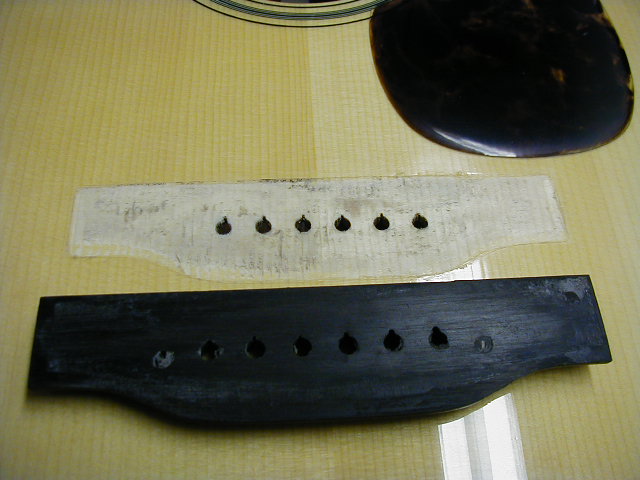
Here is the same bridge removed. You can clearly see the
excess finish. I like to scrape this away and then re-glue the bridge,
usually with hot hide glue. This will result in an overall more
robust sound.
Here's a cleaned-up bridge and patch ready for regluing. |
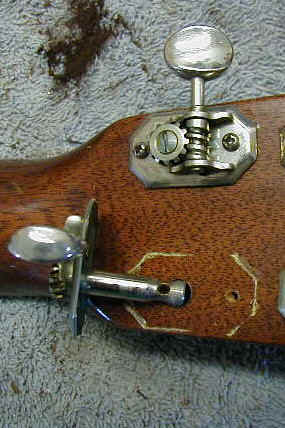 '50's Martin with open-back Klusons
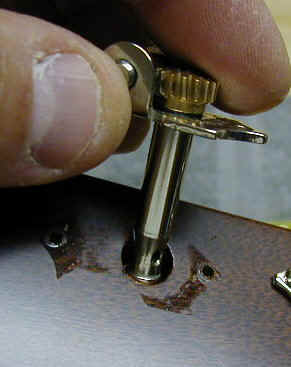
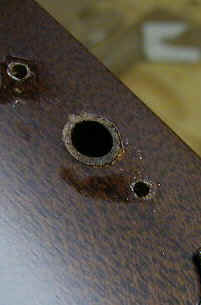
D-18 GE with oversized holes
 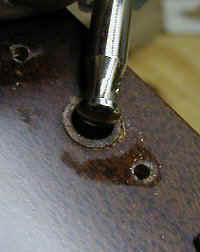
|
UPDATE: I have almost quit doing this modification because it makes
the tuner harder to turn and therefore gives them an inconsistent feel.
It does help the sound, but for most people, the stiffer feeling tuner
is not worth the slight increase in sound. The pegheads on old Martins were drilled in two-steps- a larger hole for the tuner grommet, and
a smaller hole for the tuner shaft. New ones use a single big hole. This means
that the tuner shaft is hanging in dead-air. The tuners catch a lot of vibrations-
strum a big chord with your hand resting very lightly on the buttons if you don't believe
me. I plug the holes with a walnut dowel and re-drill for the tuner shaft so that it
makes contact with wood. The tuners will turn just a little stiffer, but they're
also supported along the entire shaft which has to help dampen rattles and unwanted
vibrations.
This modification by itself doesn't do much, but it works well in
combination with the popsicle brace removal.
|
 |
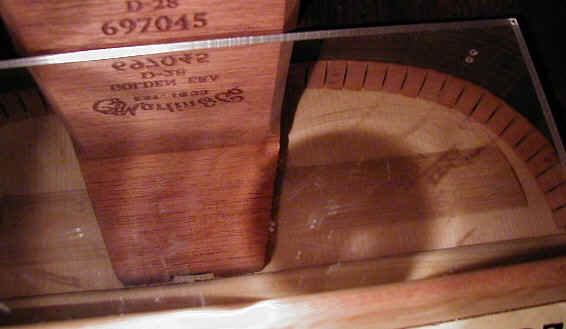
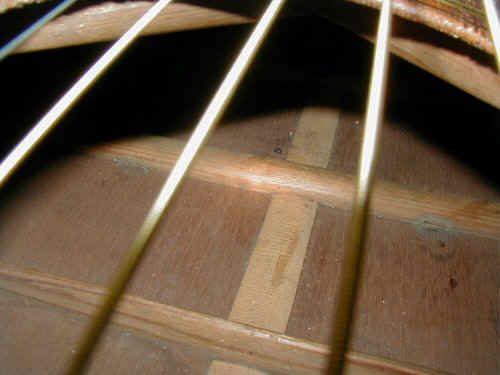
New Martins have a "popsicle" brace and truss rod
cover, neither of which were used in late 30's D-18 and D-28's. This brace was added to
prevent cracks alongside the fingerboard (the ebony fingerboard and spruce top expand at
different rates, and the ebony fingerboard bears down pretty firmly on the top. In
the bottom shot, both the brace and the cover are removed (I no longer remove
the truss cover as I feel that offers good support to the top at little or no
sound cost). (Dark lines are scratches
in the mirror, not the top). This gives the sound an "airy" quality and is
noticeable sound-wise. I think that this portion of the top picks up vibrations
not from the bridge but from the neck itself, since the fingerboard lies right on
it. I notice that the more sound I capture in the tuners and headstock, the more
noticeable the absence of the popsicle brace. Be warned: this will void your warranty and may cause cracks in the
future. If you are concerned about either and/or "collector's
value" do not do this modification. I am not responsible if
cracks develop.
Click here for a whole page on
popsicle braces.
|
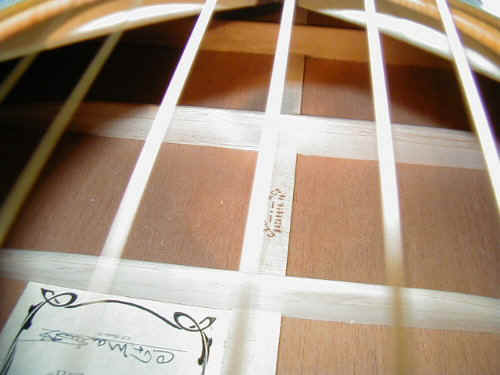 |
Pre-90's Martins had two sizes of back braces- taller ones in the
front and lower ones in the rear. In the mid-90s, Martin changed
this to 4 tall braces. The resonant frequency of the back also
changed (higher pitch). I can shave the rear two braces back to
the older 1/2" height for increased bass and richer overall sound.
|
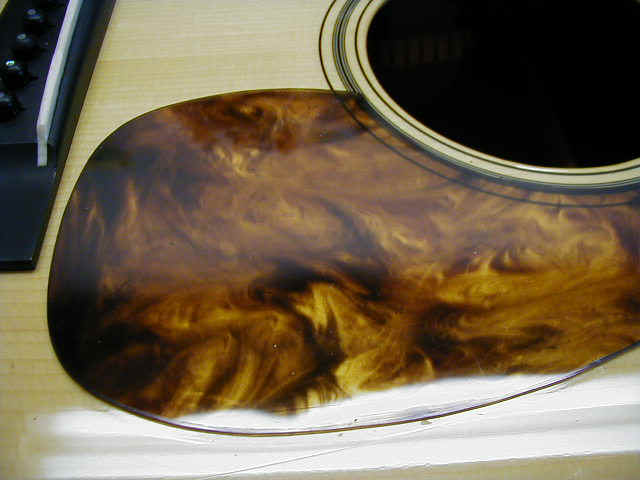 |
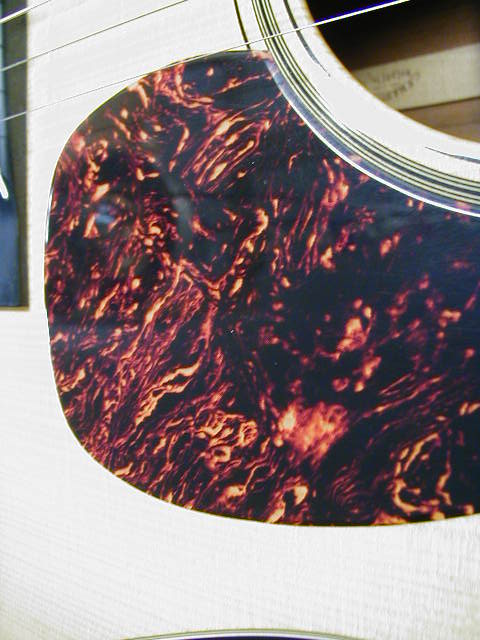
UPDATE: Martin's changed recently to a Delmar pickguard which,
frankly, I like a lot.
For many years, Martin used a dot-matrix pixelated pickguard that
looks kind of so-so. A popular upgrade is to remove it and install
a Tortis or celluloid pickguard.
More pickguard info |
That's the basic tune-up to the GE's specifically and most Martins in
general. These modifications push the guitars a little closer to the older
guitars and, with the possible exception of the popsicle brace
removal, do nothing to compromise the structural integrity of the guitars.