Your best bet
is a guitar store. They usually have boxes for free or for
$5-10 or so. Lacking that, you can order them from
Uline. Unfortunately, minimum order with them is 5 boxes which will
run you about $45 shipped. I usually keep the Uline boxes in stock
to use for shipping back guitars shipped to me in OS2 boxes, but since UPS bills
by size, it'll cost $45 or so to ship the empty box to you! If you can't find
a box locally, buy 5 from Uline and sell the leftovers to your friends.
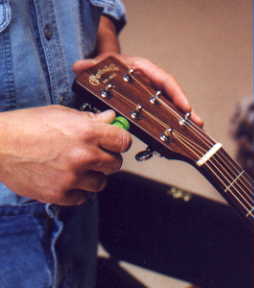 |
First thing to do is loosen the strings. You can ship it under full-tension,
but I just like to loosen the strings a full step. |
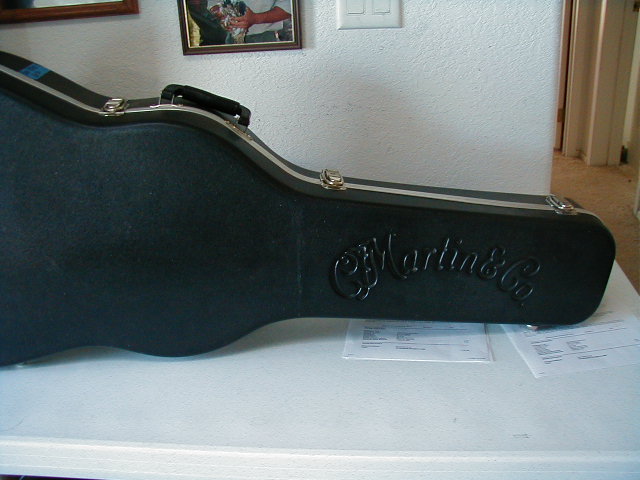 |
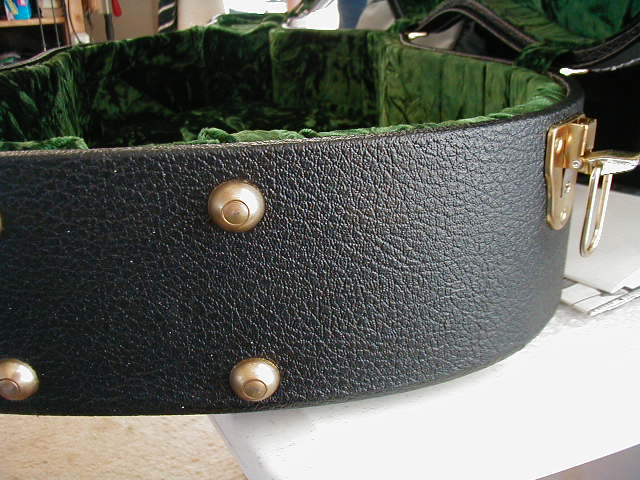
If you're using a thermoplastic case like this one, take extra care
to pad the butt and shoulders of the guitar inside the case. These cases have
sharp corners (feel for yourself!) and almost no actual padding. See the next 2 pictures
for details. |
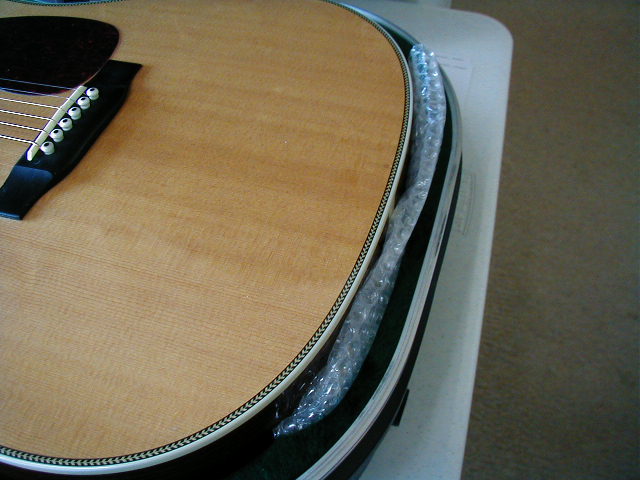 |
The butt of this guitar is padded with small bubble wrap. Just
lay a single thickness down in the case and set the guitar into it. |
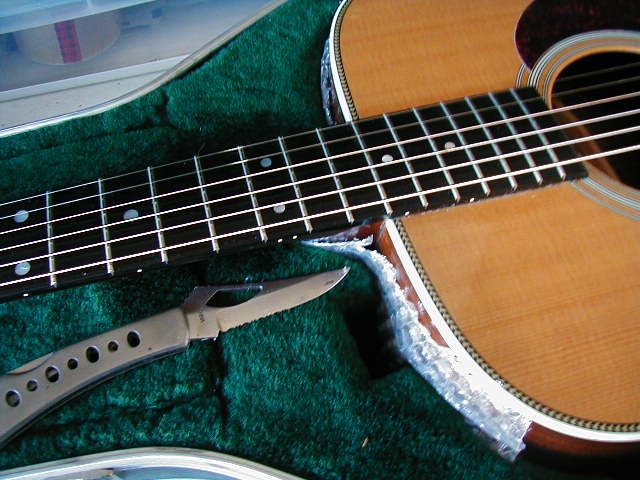 |
Likewise, be sure to pack around the front of the guitar. The
corners of these cases are very sharp and hard where the neck heel fits.
I've had two guitars (out of a couple hundred) suffer small cracks.
Just pack 'em with small bubble wrap. Remember- your padding MUST
be compressible. That is IT should take the shock, not the guitar.
If you use a towel or something like that, it'll simply transmit the
shock to the guitar. |
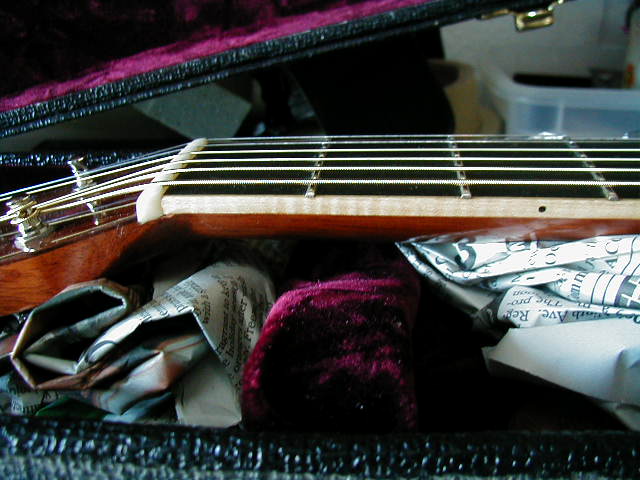 |
Add some padding under the headstock, so that you have to press the headstock gently
into the padding. Add padding under the neck along the case accessory
pocket. I like crumbled newspaper best. Don't use flat newspaper
or anything flat- you might as well not even use it. My goal here
is to immobilize the neck, not just cushion it. Do your cushioning
outside the case, between the case and the box. In other words, I
don't want this neck/headstock flexing at all; to flex is to break.
You do not want the neck resting solely on the neck support.
In this picture, the neck is clearing the case's neck support by a good
1/2" or so. When the newspaper is compressed, it will come down
but do not let the weight of the neck rest solely on the support!
Last thing is make sure your under-headstock padding follows the
angle of the headstock. Don't prop the logo end of the headstock
up. |
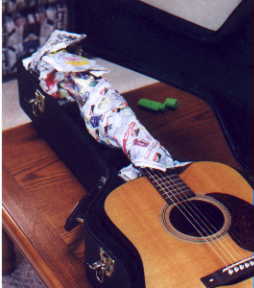 |
Pad the top of the neck to push it down into the padding beneath. You don't need a lot,
just enough to keep things from shaking around. Add some newspaper along the sides, if
necessary. Again, just take up the slack. If your endpin will come out, it's a good idea
to remove it and put it in the accessory pocket. Check for anything that might come loose
during shipping- especially 9V batteries for pickups. Take 'em out and pack them.
Note that this paper is crumpled, it is not laid flat. If
you just wrap the neck w/ paper, you're wasting your time. Crumple
it! I would NOT place anything on the guitar top. Any material
on the top will have to be weaker than the top, or else the top itself
will break during an impact. If you put a brick on top of an
egg in an egg carton and hit the carton, what happens? The egg breaks.
If you put some bubble wrap on top of the egg and hit the carton what
happens? The egg breaks. But, if you have 1/2" of dead air
on top of the egg, and then hit the carton what happens? Hopefully, the
carton itself will absorb the blow and the egg will survive. Thus,
I think it's better to leave dead air between the case and the guitar
top. |
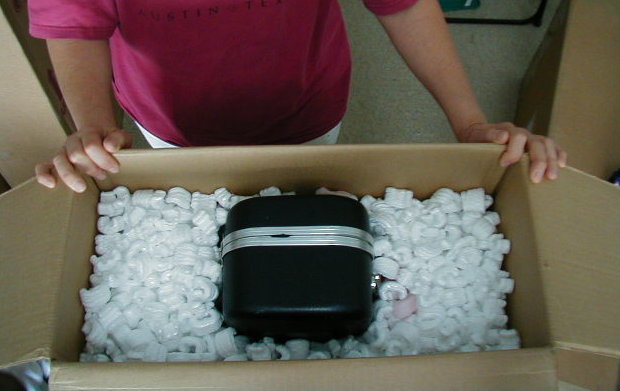 |
I like Taylor, Gibson, and Guild boxes the
best because these have a top and bottom suspension system. I
don't like to rely on just the suspension, but like to add packing
material to
this. If you don't add extra padding and there's an impact, you've
got nothing between the cardboard and the case. Styrofoam peanuts
add a lot of "bounce" to the box, take repeated impacts, are light, and
add quite a bit of insulation. Try to get some between the back and
front of the case as well. Craft paper (the heavy brown stuff) and
heavy duty bubble wrap are acceptable 2nd choices.
If you use must use newspaper, crumple each sheet separately into a loose ball-
don't just stuff whole sections of the paper in there. I suggest
taping an address label to the guitar case itself.
|
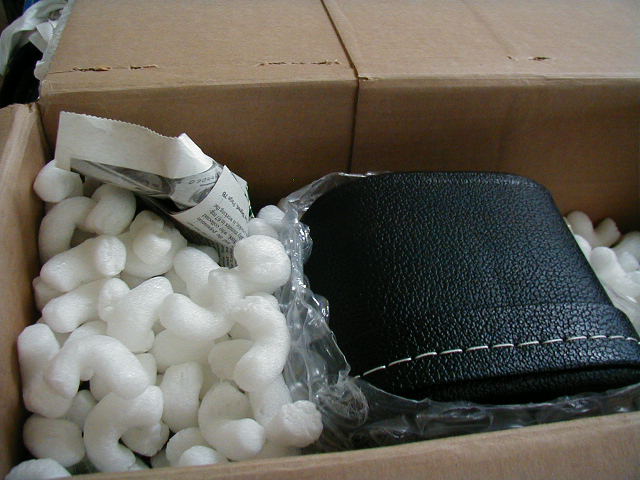 |
Bad!! Bad!!
This guitar is
packed not only with paper mixed in with the peanuts, but the case
itself is wrapped with bubble wrap. Packed the way I like it, I can nearly
always wiggle the case out w/out dumping all the packing out on the
floor, but that won't be the situation here. I will have to remove all
the packing material, making a mess all over the place. Clear
plastic tape sticks extremely well to bubble wrap and I will have
to CUT the bubble wrap off the case; it's tricky to not cut your case in
the process AND I will not be able to re-use your packing material.
Please don't do this.
Please don't do this.
Please don't do this.
|
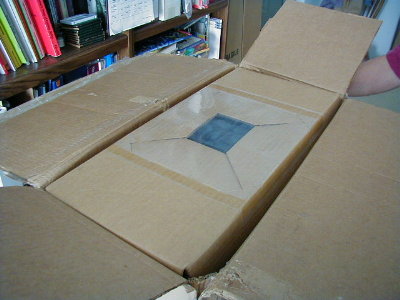 |
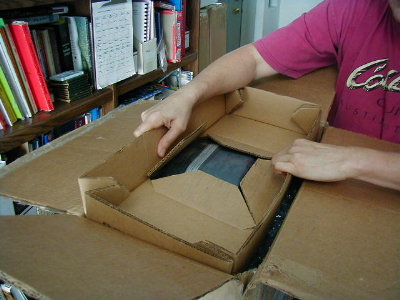
This
is wrong. f you use the suspension, use it right- the plastic goes down and
you will have to push it down while you close the lid. |
 |
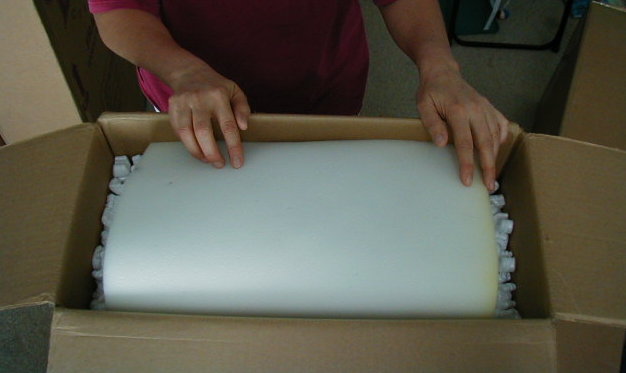
This is the right way to do it. Put one end in, hold it
down with the flap at that end, then push the other end down, and use
that flap to help push/hold it down. The fold the long flaps over. |
 |
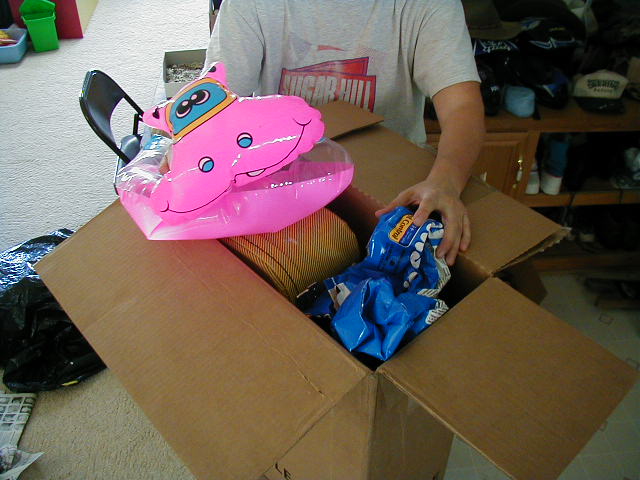
A foam pad is
a good idea if the box doesn't have a suspension system. |
 |
Air bags are marginally acceptable as padding, but they
don't offer "second impact" protection (that is, once they've taken a
hit, they pop and now you have no protection in case of a second hit), don't offer any insulation, and often go
flat while your guitar is being worked on. I have to re-use the same packing
material that you send me with 1 exception: T-shirts and towels and sheets!
These will NOT be returned. Don't pack with them. If your guitar is
damaged with packing material like this be assured that UPS will not
cover the claim. |
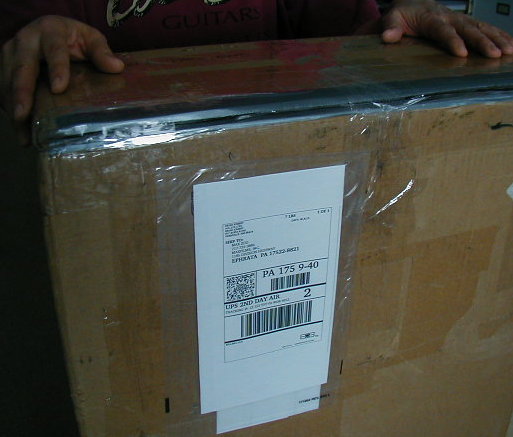 |
Seal the box up with good quality packing tape. Add your address label, along with
phone numbers of both receiving and sending parties.
There is no need to write addresses in HUGE letters on the box!!!
UPS doesn't use
them and I have to black them out on the return shipment to make sure
they don't send the box back to me. This labels is what Fed Ex and
UPS use and they all like a clean box with a clear address label.
For shipping, I use UPS ground
75% of the time with few problems. A few packages have been mis-routed and taken twice as long to get
here, but 90% of the time they'll be fine. If you want to pay more, 3-day Select is good.
Ship on Monday if possible to avoid over-weekend warehouse stays. Fed Ex is probably the
best way to ship more valuable instruments. |
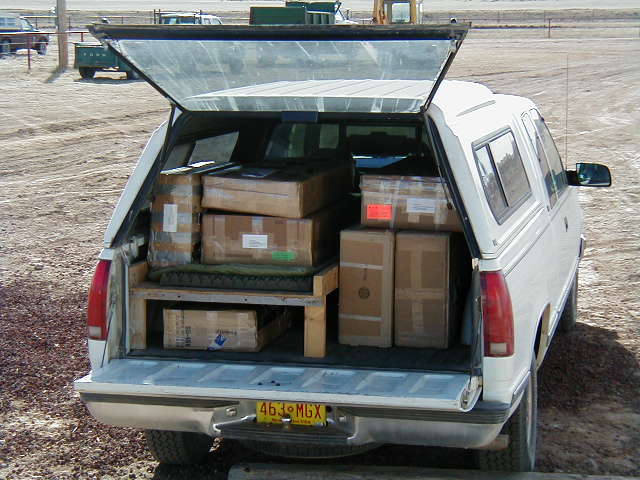 |
I ship about 150 instruments every year. Here's a particularly busy day back
when I was still making the run to UPS. Now, I just have a deal
with my UPS man where he swings by my house on Monday and picks them up.
If the weather's bad or he's in a big hurry, I'll meet him out on the
highway. |
Damage is rare, but it can occur. As of May 2017, I have had 6 damaged
guitars. 2017 - 1999 = 18 years. 150 guitars/year = approx 2700 guitars
shipped in and out for a total of 5400 transportations. 6/5400 = 0.11%.
Your guitar has a 99.89% chance of getting here undamaged. Those are good
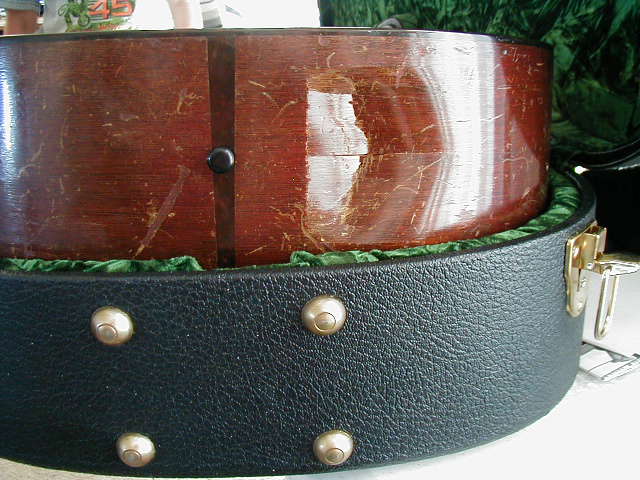
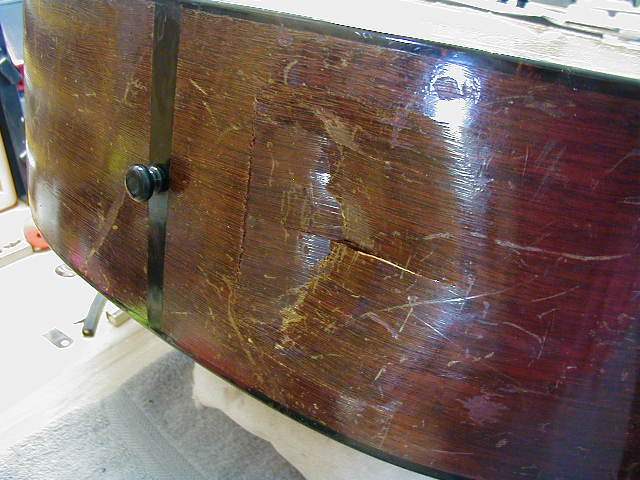
odds. Even so..... here's an example. I've had TWO damages exactly
like this, by the way. Three more were cracked necks and the last was a cracked
top.